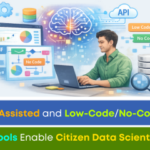


Why ISVs Are Designing for Citizen Data Scientists

During a routine product review call with a mid-sized software company that had embedded analytics into its platform, I was shocked to learn that customers had begun building their own Predictive Models. These were regular business users who were pulling data, identifying patterns, and running their own forecasts without asking IT for help or waiting on a data science team to become available.
That moment made me realize that something fundamental had shifted, not just inside that one product, but across how Analytics works inside ISV platforms today.
The Shift That Snuck Up on Everyone
Business users exploring data, identifying drivers, and building models on their own is a gradual shift that many organizations are experiencing today. Not long ago, they were receiving dashboards and Visualizations they could filter, sort, and drill down a level or two. Anything more complex than that went to IT or the data team, who built what was needed and handed it back, usually two weeks later. That model felt rational because most analytic tools required expertise that many business users did not have.
However, modern Augmented Analytics platforms now do the heavy analytical work automatically; they select algorithms, test model fit, surface key drivers, and present outputs in a way that a business user can act on without needing to understand the statistics behind it. The expertise did not disappear but moved into the platform itself, which meant the person sitting at the screen no longer needed to carry it personally.
- The Bottleneck Was Always Access: Most organizations have people who understand their own business data better than any outside analyst ever could. A sales manager who has spent eight years watching customer behavior knows things that do not show up in a training dataset. What they lacked was access to tools.
- Domain Knowledge Became the Competitive Advantage: When a finance lead builds a churn model using their own understanding of which customer behaviors matter, the output is often sharper than one built by a technical team working from the outside in.
- ISVs Had Built for the Wrong Person for Years: Most Embedded Analytics features inside ISV platforms were designed with power users and administrators in mind. The actual end user, such as someone in operations or someone managing a territory, was treated as a consumer of outputs rather than a participant in the analysis.
What This Does to Product Design
Once you realize that business users are going to drive their own analysis inside your platform, the product design conversation changes completely. You cannot take a tool built around IT-mediated workflows, add a self-service label to the packaging, and expect business users to use it comfortably. The architecture, the interface, and the data model all need to be rethought around a very different starting point.
Business users today want a platform that senses what they are looking at, surfaces the most relevant analysis automatically, and explains its suggestions in plain, direct language. The intelligence must live inside the interface, and not inside the user’s head. Here’s what it changes in product design:
- Natural Language Search Stops Being Optional: A business user should be able to type a plain question into your platform, something like “which accounts drove the most revenue decline last quarter”, and get a real, data-backed answer without clicking through four menus first. ISVs that have treated this as a nice-to-have are going to find it is rapidly becoming a basic expectation.
- Assisted Predictive Modeling Transforms Support Conversations: ISVs that embed guided Predictive Modeling into their platforms have noticed something worth paying attention to. Instead of “Can you build this analysis for us?” the questions became “Why did the model flag this variable as significant?” This means the product is doing the analytical work, and users are engaging at a level of reasoning that drives business decisions.
- Explainability Determines Trust: A business user who builds a forecast and acts on it needs to understand why the model said what it said. A prediction score with no supporting explanation creates doubt, and doubt kills adoption faster than any usability problem. ISVs that invest in showing users which factors drove an outcome and how much each one contributed will see engagement levels rise.
Who Actually Owns the Insight Now
Self-Service Analytics does not just change how analysis gets done. It changes who inside a customer organization feels responsible for the analytical output, and that ownership shift has real consequences for ISVs at renewal time.
When a regional operations lead builds their own demand model inside your platform, they begin advocating for the platform in internal budget conversations and sending feedback when something breaks. That kind of relationship with a product is enormously more durable than the relationship a passive dashboard consumer has.
- Stickiness Comes From Ownership, Not Just Features: An ISV platform where business users have built their own models, their own views, and their own analytical habits over twelve months is very hard to displace. The switching cost is no longer just about feature comparison; it is about walking away from everything those users have built and understood inside your product.
- The Citizen Data Scientist Model Rewards Progressive Design: Business users who step into this expanded analytical role do best when the platform actively supports their growth over time. That means in-product guidance that meets them at their current skill level, contextual suggestions that help them go deeper when they are ready, and a design that makes curiosity feel rewarded rather than risky. ISVs that build progressive capability into their platforms see substantially better long-term engagement than those with a flat feature set.
- Analytics Becomes the Reason Customers Stay: When analytics is built around what business users genuinely need to do, forecast demand, identify risk drivers, compare performance across segments, and predict outcomes, it becomes a daily workflow. Products that achieve that level of integration into a user’s working day are significantly harder to replace.
What ISVs Should Be Doing Differently Right Now
ISVs positioned to win in this environment are those who have understood what has already shifted inside their customer accounts and have rebuilt their Analytics Layer around the person now at the center of the process: a capable, motivated business professional who knows their domain deeply but has no interest in writing code or waiting on a backlog.
Embedding Analytics that is genuinely self-service in its architecture empowers business users to feel more capable and more confident. ISVs that get this right witness their engagement metrics and renewal conversations change. The product team gets feedback that is richer, more specific, and more useful than anything they received when only technical users were engaging with the analytics layer.
FAQs
1. Can non-technical business users really build predictive models on their own?
Yes. Guided, no-code augmented analytics platforms enable business users to understand the entire modeling process without requiring any statistical or programming background.
2. How does self-service analytics affect ISV customer retention?
Users who build their own models and workflows inside a platform develop strong ownership habits that make switching significantly more costly than a feature comparison.
3. What is a Citizen Data Scientist, and why does it matter for ISVs?
A Citizen Data Scientist is a business user who applies domain knowledge to run predictive analysis. ISVs that design for this user profile see deeper engagement and stronger renewal rates.
 Augmented Analytics, Citizen Data Scientist, Embedded Analytics, ISV, Predictive Analytics, Product Strategy, Self-Service Analytics, Smarten
Other posts