

Data Metrics vs. Data Context and Insight
Since its inception, the self-serve analytics market has changed, expanded and grown in its depth and capabilities. As organizations consider new and upgraded solutions, it is easy to become confused by the many options.
Should an enterprise choose the data-driven, reporting environment of dashboards with its alerts and key performance indicators (KPI) features and functionality, or the contextual, more personalized approach of an augmented analytics solution that provides meaningful insight and roles-based information?
As with every other technology decision, the enterprise must consider the technology landscape, the business user, IT and business analyst needs and the value vs. cost equation.
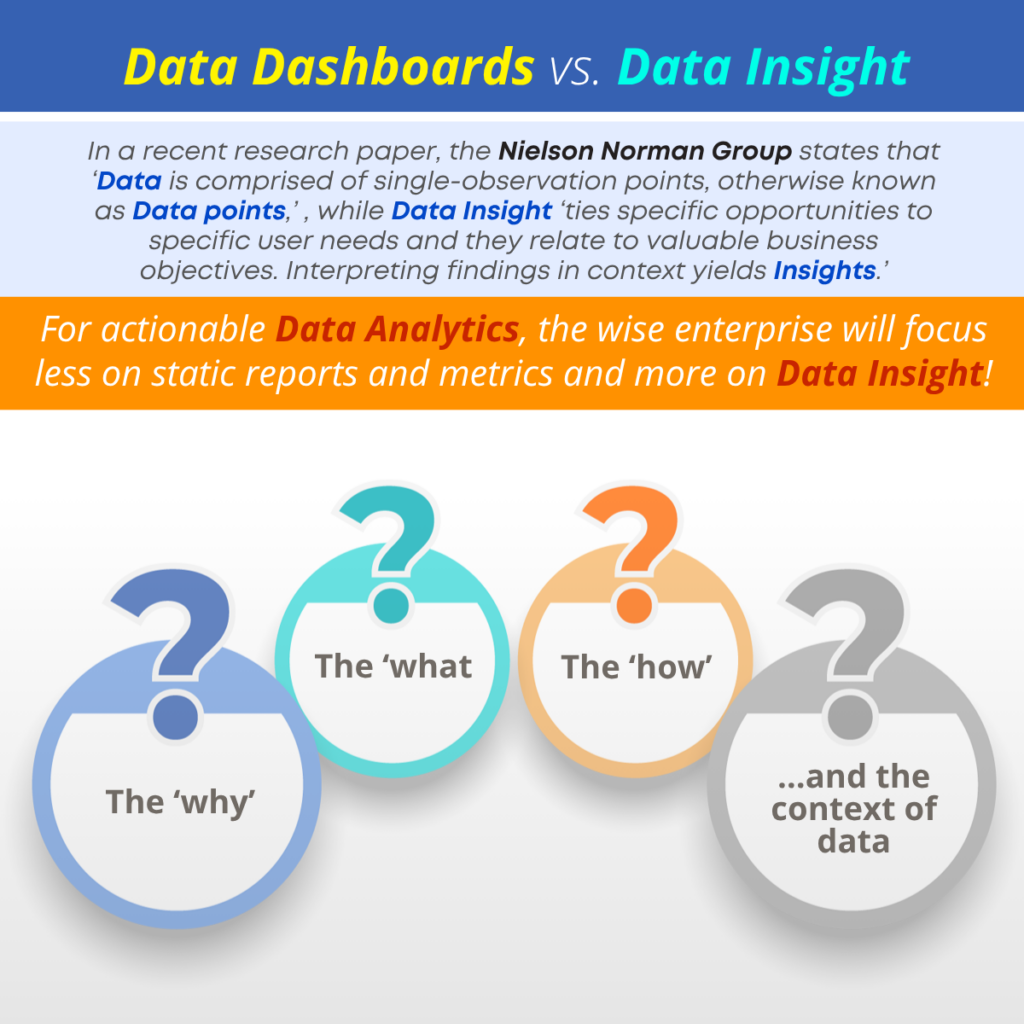
In a recent research paper, the Nielson Norman Group states that ‘Data is comprised of single-observation points, otherwise known as data points,’ while data insight ‘ties specific opportunities to specific user needs and they relate to valuable business objectives. Interpreting findings in context yields insights.’
In order to make actionable use of data, the enterprise must graduate from static dashboards and reporting to true data insight. When the organization understands data context, and the ‘why’ of the results, it can strategize how to target customers, what types of products and services to develop and what its goals and objectives should be.
The undeniable trend away from static and restrictive dashboards to meaningful data insight is driving the self-serve analytics market forward, and the reasons are clear:
Access is Not Enough – Just giving your team access to data does not make it easy to interpret or use. Dashboards and reporting environments can produce impressive presentations, but that doesn’t make the information usable or actionable.
Managing Performance – The enterprise needs actionable data insight to accurately target customers and strategize products and services, to gain insight into customer buying behavior, to control operational goals and to understand results. While dashboards can measure key performance indicators (KPIs) and produce metrics, they don’t necessarily tell the business the ‘why,’ or provide feedback on how to improve results.
Data vs. Insight – Dashboards provide lots of data in many formats for many users, but they don’t offer a clear picture. Metrics are often presented to management but rarely produce actionable plans. Teams can refine measurements and yet see no meaningful improvement in results. Key Performance Indicators (KPIs) can offer a wealth of data, without prioritizing targets or actions.
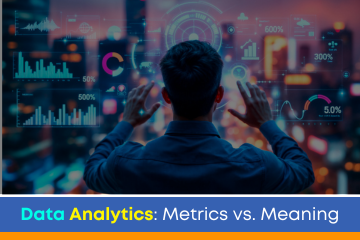
Metrics vs. Meaning – When business users and managers leverage metrics alone, they are counting on measurements to direct them, but those metrics do not necessarily reflect the value of a change or adaptation to the business or to the customer. When metrics alone drive action, the team can miss important insight into the more subtle meaning of results, and the true root cause of an issue, an influence, or a relationship buried beneath secondary causes or redundant data.
Targeted Insight – Dashboards reflect frequency, volume and visualizations. Insight supports understanding of results and the underlying data, and enables planning and action.
Context driven analytics and data insight allows for a more meaningful understanding of data, while still providing a deep foundation of metrics upon which the executive team can depend. It reflects the ‘why’ and the ‘how’ of results and customer interaction, product and service offerings and business offerings, and it enables business users in all functions to see results in a way that is pertinent to their role and responsibilities.
So, when your business is considering the value of simple dashboards and reporting versus the value of sophisticated, insightful analytics, it is important to remember that sustainable results come from a real understanding of your market, your customers and users and your competition.
Rather than producing lots of reports and a large volume of hard-to-interpret data and metrics, the enterprise should focus on the why, how, and what of its data and, with that insight, create a plan of action for the future of its business.
Contact Us to find out more about how your business can incorporate true data insight and self-serve analytical products and services into its culture and technology landscape. Start with a suite of products that will ensure Data Quality. Explore our free webinar on Data Quality And Data Insight.
Original Post : Data Analytics: Metrics vs. Meaning!
 Augmented Analytics, Data Governance, Data Insight, Data Integrity, Data Quality, Data Quality (DQ), Data Quality Management, Data Quality Tools